
Batched disputes are moving to a shorter cooling-off period – and a much shorter window to file once it ends. Here is what is changing on November 1, and how initiating and non-initiating parties can prepare.
On Nov. 1, 2026, the Federal IDR portal will begin enforcing several batching provisions from the Federal IDR Operations Final Rule, published in the Federal Register on June 4, 2026. CMS outlined the system changes in its recent notice, “Coming Soon: Changes to Batching Disputes.”
For batched disputes with open negotiation periods that begin on or after Nov. 1, two timing changes take effect:
- The cooling-off period after a batched payment determination drops to 30 business days from 90 calendar days.
- Once that cooling-off period ends, parties have 4 business days – down from 30 – to initiate the Federal IDR process for held-over items. These are items or services whose open negotiation period ended within the cooling-off period.
The shorter cooling-off period means less waiting. The shorter initiation window means less room for error. The Notice of IDR Initiation web form will block disputes filed before the cooling-off period ends or more than 4 business days after it ends. Batched disputes, per the final rule, will be limited to 50-line items.
What stays the same
Single and bundled disputes, on any date, keep the statutory 90-calendar-day cooling-off period. So do batched disputes whose open negotiation period began before Nov. 1, 2026. In both cases, parties still have 30 business days after the cooling-off period ends to initiate the Federal IDR process for held-over items. CMS added a portal check on Sept. 24, 2026, that enforces that 30-business-day limit.
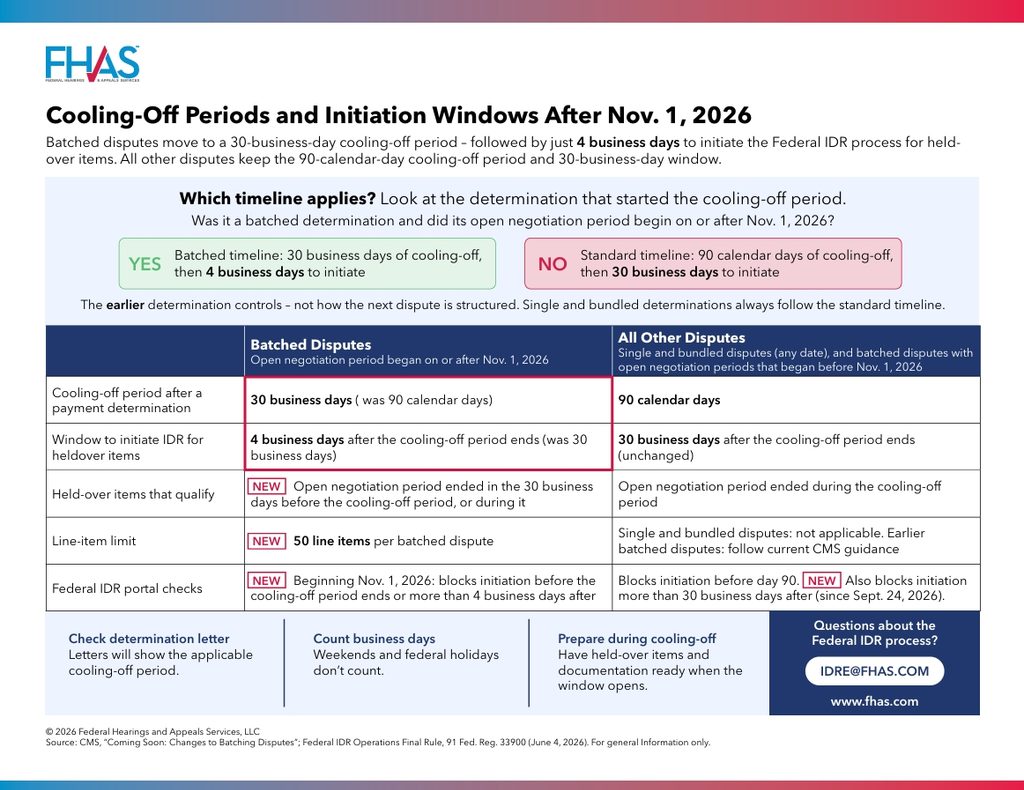
Downloadable chart: “Cooling-Off Periods and Initiation Windows After Nov. 1, 2026
Two things to understand about the new timing
1. The earlier determination sets the clock
Which cooling-off period applies depends on the payment determination that started it – not on how the next dispute is structured. Under the final rule, a batched determination is followed by a 30-business-day cooling-off period, and a single determination is followed by a 90-calendar-day period. Batching the next submission does not shorten a 90-day period that a single determination has already started. CMS says payment determination letters will show the correct cooling-off period based on the dispute type and open negotiation start date, so the letter is the best place to confirm which clock applies.
2. The cooling-off period limits the party that initiated
Under the final rule, the cooling-off period bars the party that initiated the earlier dispute from initiating a new one against the same other party for the same items or services. For example, if a dispute involves a self-funded plan, the cooling off period only applies if the subsequent dispute involves the same self-funded plan, the same group number, and the same items or services. Once the cooling-off period ends, either party may initiate the Federal IDR process for held-over items. The final rule also notes that overlapping cooling-off periods can apply, so parties with frequent disputes involving the same items and the same other party may be tracking more than one period at a time.
Guidance for initiating parties
Track every determination
For each payment determination, record the date, whether the dispute was batched or single, the funding type for that determination, the group number if self-insured, and the open negotiation start date. These facts determine both the cooling-off period and the window that follows it.
Count in business days
Build deadlines that exclude weekends and federal holidays, and set internal targets at the start of the 4-business-day window rather than the end.
Prepare during the cooling-off period
Identify held-over items as their open negotiation periods close, confirm they meet batching criteria, and assemble the batch – up to 50 line items – and supporting documentation in advance, so the dispute is ready to submit when the window opens.
Do not file early
The portal will reject initiations submitted before the cooling-off period ends, so confirm the end date before submitting.
Keep negotiating
The cooling-off period is designed to encourage resolution through open negotiation. Using that time to negotiate may reduce the number of items that need to go back into the Federal IDR process at all.
Guidance for non-initiating parties
Track the same dates
Knowing when the cooling-off periods end, and when the 4-business-day windows close helps teams anticipate new disputes and respond to notices promptly. Be sure to account for federal holidays.
Document cooling-off objections
The final rule asks a party that believes a dispute is ineligible because of a cooling-off period to provide supporting documentation when contesting eligibility during certified IDR entity selection. Documentation includes proof of a prior payment determination involving the same items or services and the same other party and also should include the funding type and group numbers for both the initial cooling off dispute and the current dispute.
Check the determination letter
Because letters will reflect the applicable cooling-off period, they are a reliable reference for confirming whether a new dispute was filed within the right window.
Use open negotiation
Shorter cycles mean held-over items can return to the Federal IDR process sooner. Engaging in open negotiation during the cooling-off period gives both parties a chance to resolve those items first.
Remember that either party may initiate
After the cooling-off period ends, a non-initiating party may also initiate the Federal IDR process for held-over items, subject to the same window.
Looking ahead
Because a cooling-off period begins only after a payment determination, and a determination comes after open negotiation, initiation, and review, the first four-business-day windows under the new rules are likely months away. That gives both initiating and non-initiating parties time to update tracking tools and workflows. In the final rule, the Departments also said they intend to publish clarifying guidance on the batching provisions, including how the cooling-off period applies. FHAS will share updates as that guidance becomes available.
Questions about the Federal IDR process? FHAS is a certified IDR entity. Contact our team at IDRE@fhas.com.
Legal Disclaimer
The information contained in this content piece is for general informational purposes only. While we strive to ensure the accuracy and completeness of the information presented, we make no representations or warranties of any kind, express or implied, about the accuracy, reliability, suitability, or availability with respect to the content or the information, products, services, or related graphics contained in the content piece for any purpose. Any reliance you place on such information is therefore strictly at your own risk. The content of this page is subject to change without notice. The information provided in this document does not constitute legal or other professional advice, and is non-binding upon FHAS and any federal government agencies.