The Cooling Off Period: What Providers and Health Plans Need to Know
Updated for the 2026 Federal IDR Operations Final Rule (CMS-9897-F).
The “Cooling Off Period” under the federal Independent Dispute Resolution process has been a consistent point of confusion – and often frustration – for all parties. Under current IDR guidelines, initiating parties may face a 90-calendar-day cooling off period limitation before they can initiate another dispute involving the same party and services.
The following guide recaps existing guidelines for the cooling off period and notes the pending changes that will apply to batched disputes under the Final Rule.
When the Cooling Off Period applies
For a new claim to be restricted by the cooling off period, it must meet these criteria under current rules. The Final Rule makes no changes to these criteria.
- The claim must be between the same parties as the preceding claim.
- It must involve the same items or services that were subject to the initial Notice of IDR Initiation.
- The payment (or notice of denial of payment) for the qualified IDR items or services would be made by the same group health plan or health insurance issuer or FEHB carrier;
- For fully-insured health plans, this means that a cooling off period can apply even if the qualified IDR items or services relate to claims from different fully-insured group or individual health plan coverage offered by the issuer;
- For self-insured group health plans, this means that a cooling off period can only apply if payment is made by the same plan, even if the same third-party administrator (TPA) administers multiple self-insured plans.
- For FEHB carriers, this means that a cooling off period can only apply if payment is made by the same FEHB carrier, even if the qualified IDR items or services relate to claims from different FEHB plans offered by the carrier.
For a cooling off period to apply, the current and previous dispute must contain the same health plan funding type.
- A final payment determination was made for the previous dispute.
If a claim differs in any one of the above criteria, the initiating party is free to submit a new claim without waiting for the cooling off period to conclude.
Example: If a patient received multiple services and one was previously decided, a new claim could be initiated as long as it’s not related to the same services.
When the Cooling Off Period begins
Under current regulations and the Final Rule, the cooling off period starts the first day after a payment determination is made by the IDR entity (IDRE). The cooling off period applies even if a different IDRE is selected to manage the new dispute.
Additionally, subsequent determinations where cooling off applies will reset the cooling off period if determined with the same service code and the other criteria for it to apply are met.
Example: If a dispute determined on 1/1/26 starts a cooling off period, a subsequent determination made within this period, e.g., 2/1/26, would restart the period to begin on 2/1/26 and therefore end on 5/1/26.
An active Cooling Off Period changes the IDR initiation deadline.
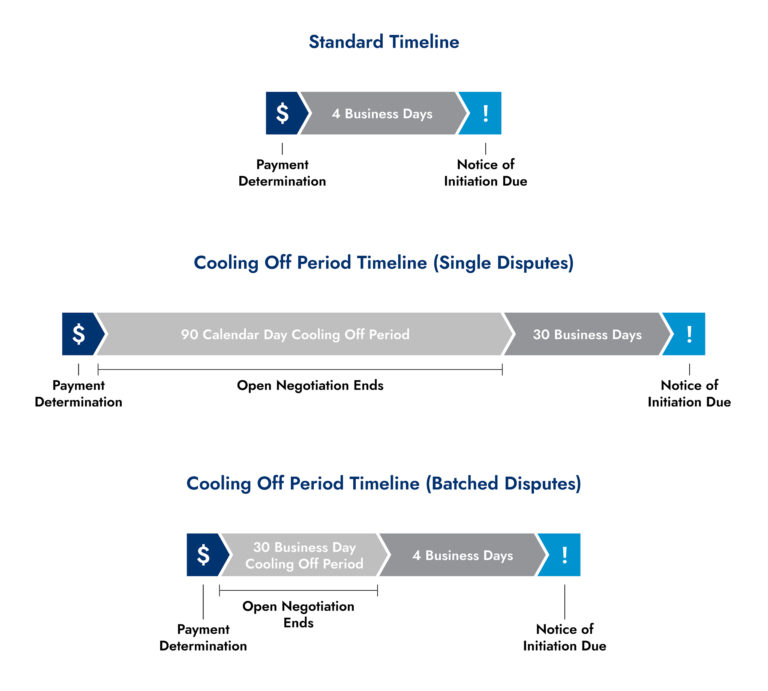
Typically, an initiating party must submit a Notice of IDR Initiation within 4 business days following the end of an open negotiation period. However, this standard 4-business-day deadline changes if/when the open negotiation period ends during a restricted cooling off period.
In these cases, the Notice of Initiation (for same items exiting the open negotiation period) is due within 30 business days of the end of the cooling off period.
To assist parties in determining cooling off period dates and initiation deadlines, FHAS has launched a Cooling-Off Calculator to help clarify information for specific disputes.
Coming Impacts of the Final Rule: What will change, and when?
Full details were published in the Federal Register on June 4. The cooling off period changes made under the final rule will apply only to batched submissions.
Under the Final Rule, for batched determinations only, the cooling off period is shortened to a 30-BUSINESS-DAY window rather than the 90-CALENDAR-DAY window. This is a double change — a shorter period and a switch from calendar days to business days — so parties recalibrating their timelines should take care not to apply the old count.
When does this change take effect?
The Final Rule’s provisions will phase in at different times. The best advice is to stay tuned for further guidance from CMS, or from your trusted IDRE. Regarding the new batching and cooling off period provisions, the Departments have advised that:
- Gateway-dependent changes — including the 30-business-day cooling off period apply to disputes with open negotiation periods beginning 90 business days after the Departments issue guidance that the supporting IDR Gateway functionality is available.
- Parties should confirm with their trusted IDRE and/or further CMS guidance the specific deadlines that apply once each provision is operationalized. The FHAS cooling off period calculator will adjust to correct timeframes as each provision becomes effective.
- Until then: the existing 90-calendar-day Cooling Off Period remains in effect for batched disputes.