
This post is the latest in our Common Questions series, which addresses recent, recurring questions asked by our Account Services teams. Read on to hear what parties are asking and how we are responding
The 2026 Federal IDR Operations final rule rewrote one of the earliest steps in every dispute: how the entity that ultimately is responsible for the dispute is decided. Recently, FHAS’s Account Services team has been fielding a number of questions related to these changes, which we will endeavor to answer here.
Simply stated, the basic choice is the same as before. What is new is the structure around it. Federal IDR entity selection now runs on a fixed schedule; every step is a notice in the IDR Gateway, and every deadline is counted in business days, with the date of IDR initiation as day 0. Throughout this post, “day” means business day unless otherwise noted. Here is what changed, why, and what it means for the way you work.
Why has the process changed?
Under the earlier process, entity selection depended largely on informal back-and-forth. The initiating party named a preferred IDRE in its notice; the other party had three business days to object and propose an alternative, and if the two sides could not agree by day 4, a random selection followed. If the NIP responded at the eleventh hour, the case would often result in a random selection of IDRE instead of allowing the IP to potentially accept their proposed IDRE. The steps were clear enough, but the timing and record-keeping were not uniform, and a dispute could stall before it had properly begun.
The revised rule addresses that by moving selection into the IDR Gateway, where each action is a time-stamped notice, and by setting deadlines that resolve on their own. The goal, consistent with the rule’s broader emphasis on standardizing steps, improving communication, and reducing delay, is to encourage the parties to agree on an IDRE and limit how many cases are being randomly assigned to an entity.
What has changed and what has not changed?
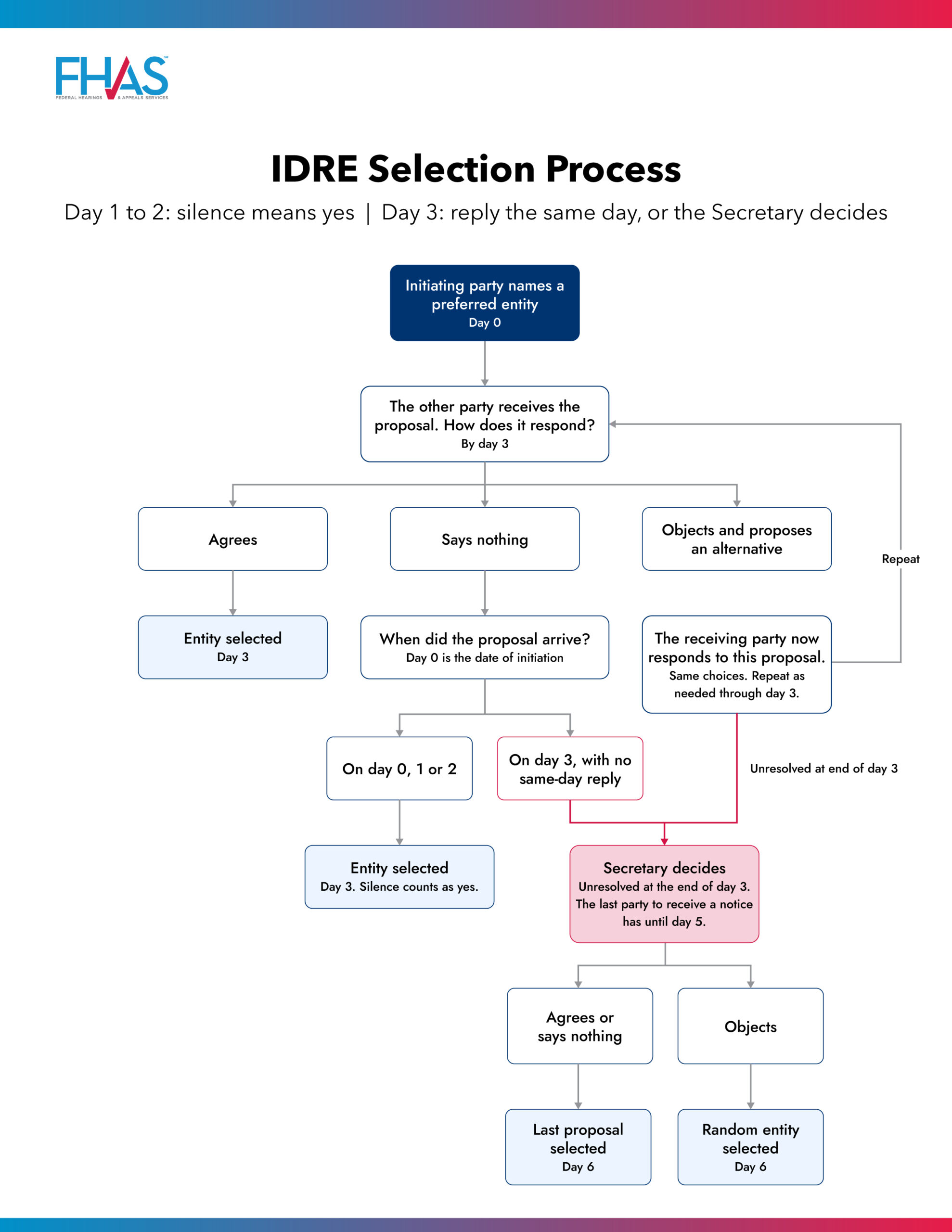
Downloadable image: “IDRE Selection Process”
The initiating party still names an IDRE first as part of the dispute initiation process in the federal IDR Gateway. If the other party agrees, or says nothing, by day 3, that entity is jointly selected on day 3. In effect, this step works the way it always has, albeit in the Gateway portal.
Objections must name an alternative entity. An objection is no longer simply a “no.” The objecting party must name an alternative IDRE and explain their objection or conflict of interest with the initiating party’s preferred choice. This counter proposal goes into a notice of certified IDR entity selection in the Gateway.
Silence = Agreement, and timing matters. An alternative proposed by the non-initiating party on day 1 or day 2 is accepted if the initiating party stays silent through day 3. An alternative proposed on day 3 requires a same-day answer. If the recipient neither agrees nor replies on day 3, joint selection fails.
The party that received the last notice then gets two more business days, through day 5, to respond. If the recipient is silent or agrees with the alternative, the selection process ends and that entity is chosen. If the recipient objects to the alternate entity named, this triggers a random selection by the Secretary from the remaining entities, excluding any that have been proposed previously.
A conflict check follows every selection. Whether chosen by the parties or by the Secretary, the selection is preliminary until the IDRE attests within three business days that it has no conflict. The final selection notice follows within one business day. If the entity does not attest, the Secretary randomly selects a replacement and notifies the parties within one business day after the attestation window closes.
How will this affect your process?
Most of the adjustment is in preparation and attention rather than new work. A few practical points:
- Remember that silence is a decision: it means agreement. At nearly every step, not responding accepts whichever entity is on the table.
- Count in business days from initiation. Days 3, 5, and 6 are the dates that matter. Build them into your dispute calendar.
- Watch for Gateway notifications. Every step is a portal notice. There is no side channel, so parties must monitor all gateway notices as they govern the clock.
- Know your preference before you initiate. Have a preferred IDRE and a fallback in mind so that an objection on day 1 or 2 does not catch you flat-footed.
- If you object, explain why. An objection has to name an alternative and describe any conflict.
- Day 3 requires a same-day response. A late-arriving alternative needs an answer before the business day ends. At that stage, parties are only able to accept or deny a proposal, and then it moves to random selection.
- Expect a short pause for the conflict attestation. The selection is not final until the entity confirms it is conflict-free, which can add up to four business days.
When does all this start?
The final rule took effect August 3, 2026, but the entity-selection provisions are tied to IDR Gateway functionality that CMS has not yet announced. According to CMS’s August 7 Implementation Timeline Guide, these provisions become applicable 90 calendar days after the Departments announce that the supporting functionality is available. CMS has not set a date, though industry observers generally expect rollout in spring 2027. Until then, the earlier selection process continues to govern current disputes. Before relying on the new steps for a specific dispute, check the certified IDR entity selection entry in Table 1 of that guide for the status.
A good moment to think about your IDRE choice
A tighter clock rewards parties who know in advance which IDRE they want. The rule gives you a short window to make that choice deliberately, so it is worth deciding what you are looking for before the first notice goes out. Four qualities tend to matter most:
- Quality. Independent accreditation is the clearest external signal. FHAS holds URAC’s Independent Review Organization accreditation and was the first organization to earn URAC’s IDR designation, which sets standards for fairness, transparency, and quality in how disputes are managed.
- Fairness and independence. Baseball-style arbitration only works when both parties trust the arbiter to weigh the facts and the offers in strict adherence to the rules and regulations.
- Service. Clear communication, timely determinations, and a willingness to explain the process and your own performance history make the difference between a vendor and a partner.
- Accessibility. An IDRE you can reach with a question – by phone or email – that will meet with you to review your approach, is an asset to your program.
For a fuller discussion, see our earlier posts on why URAC accreditation matters in choosing an IDRE and how to choose an impartial IDRE. As always, contact us, call us at 800-664-7177, or reach out directly to your account representative with any questions, concerns, or education needs.
Legal Disclaimer
The information contained in this content piece is for general informational purposes only. While we strive to ensure the accuracy and completeness of the information presented, we make no representations or warranties of any kind, express or implied, about the accuracy, reliability, suitability, or availability with respect to the content or the information, products, services, or related graphics contained in the content piece for any purpose. Any reliance you place on such information is therefore strictly at your own risk. The content of this page is subject to change without notice. The information provided in this document does not constitute legal or other professional advice, and is non-binding upon FHAS and any federal government agencies.