New Online tool aims to reduce ineligible disputes in the federal IDR process by clarifying when a state process takes precedence.
Before a provider can take an out-of-network payment dispute to the federal Independent Dispute Resolution (IDR) process, it has to know if a state IDR process takes precedence over the federal process.
The new FHAS IDR State Law Eligibility Guide answers this question in one step, for all 50 states. The online tool is now publicly available here with the goal of reducing ineligible claims from the federal IDR process.
One dropdown, two types of answers
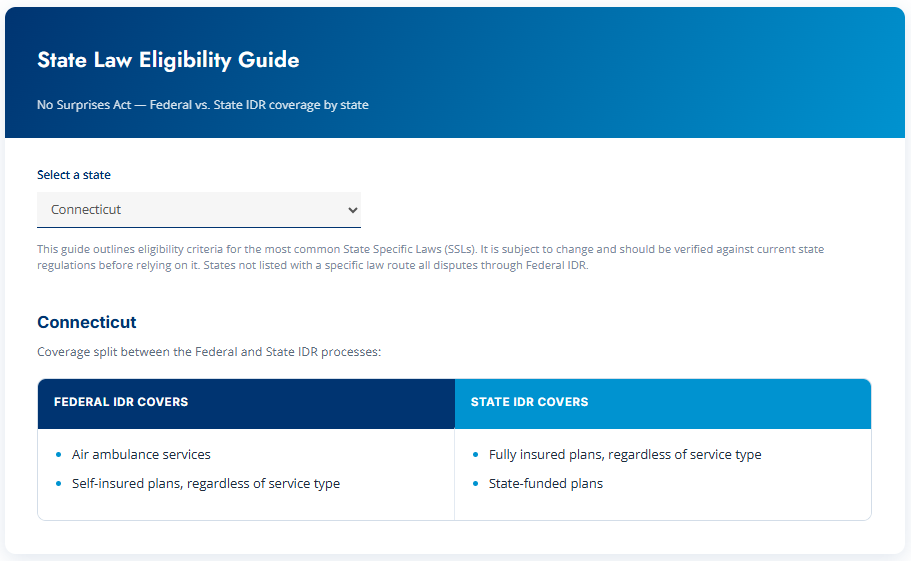
Users simply select the state where the service was provided from a dropdown menu and the tool provides guidance, as follows:
- For states without a state-specific law on file, the guide says so plainly and points the user to the federal process.
- For states with a specific IDR law, the guide returns a side-by-side view of what each process – state and federal – covers. Connecticut is a good example: federal IDR covers air ambulance services and self-insured plans regardless of service type, while the state process covers fully insured plans, regardless of service type, and state-funded plans.
The answer turns on the plan, not the patient
The No Surprises Act was written to fill a gap, not to preempt the states. Where a State Specific Law determines the out-of-network rate, that framework governs and the federal process does not apply.
But look at what actually drives the Connecticut split. Not the service. Not the diagnosis. The plan’s funding structure — self-insured or fully insured. However, the billing staff working the file sees an insurance card and a service date. They do not see whether the employer funds its own claims.
While the FHAS tool cannot identify the plan’s funding type, it informs the billing staff that the funding structure is the deciding variable in that state, prompting them to verify it before anything is filed — through the plan documents, the plan administrator or the eligibility verification the practice already runs. Information that soon will be required under the Final IDR Operations Rule should also assist in this determination.
Reducing ineligibility matters
The FHAS State Law Eligibility Guide should help route disputes appropriately at the beginning of the process, by moving the routing question to the front of the process. In addition, it covers all 50 states, so multi-state practices and RCM partners can screen consistently instead of relying on institutional memory about which state does what.
Correct routing at the outset is an efficiency measure: disputes reach the right process the first time, without the rework and delay of a misdirected filing. That is the same efficiency CMS has prioritized across the IDR program. The guide covers the most common State Specific Laws and is subject to change. Further, it does not constitute legal advice.
The State Law Eligibility Guide is live and open to anyone here.
Legal Disclaimer
The information contained in this content piece is for general informational purposes only. While we strive to ensure the accuracy and completeness of the information presented, we make no representations or warranties of any kind, express or implied, about the accuracy, reliability, suitability, or availability with respect to the content or the information, products, services, or related graphics contained in the content piece for any purpose. Any reliance you place on such information is therefore strictly at your own risk. The content of this page is subject to change without notice. The information provided in this document does not constitute legal or other professional advice, and is non-binding upon FHAS and any federal government agencies.