Account registration begins September 15
For years, the Federal Independent Dispute Resolution (IDR) process under the No Surprises Act has run on single-use web forms — a new form for every notice, no persistent record, and a lot of manual tracking. That’s about to change. CMS is rolling out the IDR Gateway, a centralized, account-based platform that will eventually handle every step of a federal IDR dispute, from the first negotiation notice through entity selection and beyond. It will offer dashboards, reports, and system timestamps that will replace manual tracking of deadlines and status.
The rollout is already underway, and account registration opens September 15, but migration to the Gateway won’t be a flip-of-a-switch event. This article walks through what’s confirmed, what’s still open, and what to do between now and January 2027.
Also, we’ve put together a one-page summary of the rollout timeline: The IDR Gateway: What’s Changing for You? Keep this handy printable reference sheet nearby, and please share with your team, too.
The Rollout Timeline
CMS is phasing the transition rather than launching everything at once:
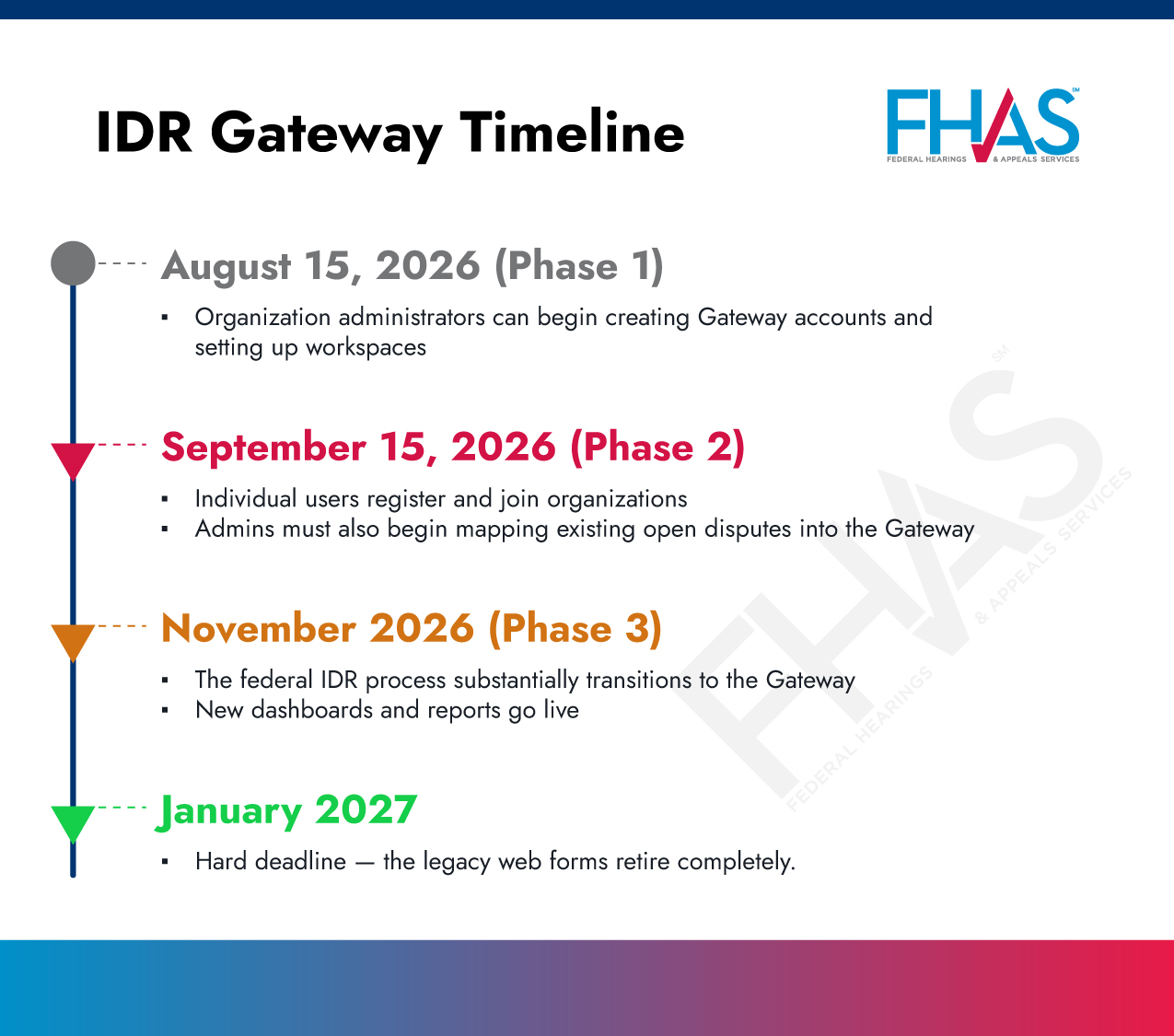
- Aug. 15, 2026 (Phase 1): Organization administrators can begin creating Gateway accounts and setting up workspaces.
- Sept. 15, 2026 (Phase 2): Individual users register and join organizations. Admins must also begin mapping existing open disputes into the Gateway.
- Nov. 2026 (Phase 3): The federal IDR process substantially transitions to the Gateway; new dashboards and reports go live.
- Jan. 2027: Hard deadline — the legacy web forms retire completely.
FHAS Can Help
We are closely tracking every phase of this rollout because it directly affects the disputes we help resolve. If you have any questions about how a specific dispute will be handled as the Gateway comes online, whether a particular filing should go through the legacy web form or the new platform, or how to prepare your organization for registration, our team is glad to help you think it through.
Reach out to us any time – we’re happy to be a resource as this transition unfolds.
It is important to keep in mind that even after you set up your account, not every function is live for every dispute. CMS will activate each function — negotiation, initiation, entity selection, withdrawals, extensions — on its own schedule, announced through a formal notice with a 90-calendar-day runway before using it becomes mandatory.
Whether a given dispute uses the Gateway or the legacy form depends on when that dispute’s open negotiation period begins, not when your organization signed up. For example, a single dispute opened near November 2026 could legitimately use the Gateway for some steps and old web forms for others.
When in doubt, default to the legacy form until Gateway availability is confirmed for that step — filing on the wrong system risks the dispute being ruled ineligible.
What Changes for Each Side
Initiating parties will use their organization account in the Gateway to file the Open Negotiation Notice and Notice of IDR Initiation. The Gateway will include the optional service-code-modifier field and block duplicate filings of the same claim, date of service, and billing code.
Non-initiating parties pick up an entirely new obligation: an Open Negotiation Response Notice, due by day 15 of the 30-business-day negotiation period. Payers also will need to disclose legal business names, plan sponsor details, and standardized CARC/RARC codes earlier in the process, with a payer registry requirement coming in a later phase.
Both sides will eventually move entity selection, withdrawal requests, and extension requests into the Gateway rather than via emails as typically happens today.
Who Needs to Register — and Who Doesn’t
Disputing parties and their representatives must have an account, including any organization or individual that processes disputes, represents a party, or submits IDR web forms today. If your organization relies on a third-party administrator, your TPA needs the account, not your organization. Certified IDR entities do not register in the Gateway.
Only U.S.-based, individually verified users can register. Verification works through login.gov or ID.me rather than CMS directly, and there are no shared or admin-created logins — every user self-registers.
What to Do Immediately
Organizations should name at least one Gateway administrator now. (CMS recommends two and caps administrators at 10 people.) Once account creation opens, watch for setup instructions, and start inventorying open disputes that will need to be mapped into the new system. Several operational details, including full sign-up steps, whether the Gateway will support API integration, and how multi-entity organizations will be handled — remain unanswered by CMS as of this writing. Until specific notice of these functions is live, keep using the current web forms.
A Quick-Reference Summary
We built this one-page, downloadable PDF summary of the rollout timeline and key changes for initiating and non-initiating parties: The IDR Gateway: What’s Changing for You. It’s designed to be a quick, printable reference you can keep on hand or share/post internally as your team prepares.
Legal Disclaimer
The information contained in this content piece is for general informational purposes only. While we strive to ensure the accuracy and completeness of the information presented, we make no representations or warranties of any kind, express or implied, about the accuracy, reliability, suitability, or availability with respect to the content or the information, products, services, or related graphics contained in the content piece for any purpose. Any reliance you place on such information is therefore strictly at your own risk. The content of this page is subject to change without notice. The information provided in this document does not constitute legal or other professional advice, and is non-binding upon FHAS and any federal government agencies.