On Oct. 29, 2026, the Departments of Health and Human Services, Labor, and the Treasury, along with the Office of Personnel Management, released guidance on the treatment of batched and bundled items and services under the Federal IDR Operations Final Rule. The IDR batching guidance explains how the new batching requirements work, lists the CPT code ranges that can be batched for anesthesiology, radiology, pathology, and laboratory services, and walks through examples for disputing parties and certified IDR entities.
The new rules apply to batched disputes with open negotiation periods beginning on or after Nov. 1, 2026. Disputes with earlier open negotiation periods follow the prior batching requirements.
To help parties get oriented, FHAS has prepared a one-page summary, “Federal IDR: What’s Changing for Batched Disputes,” available to view and download.
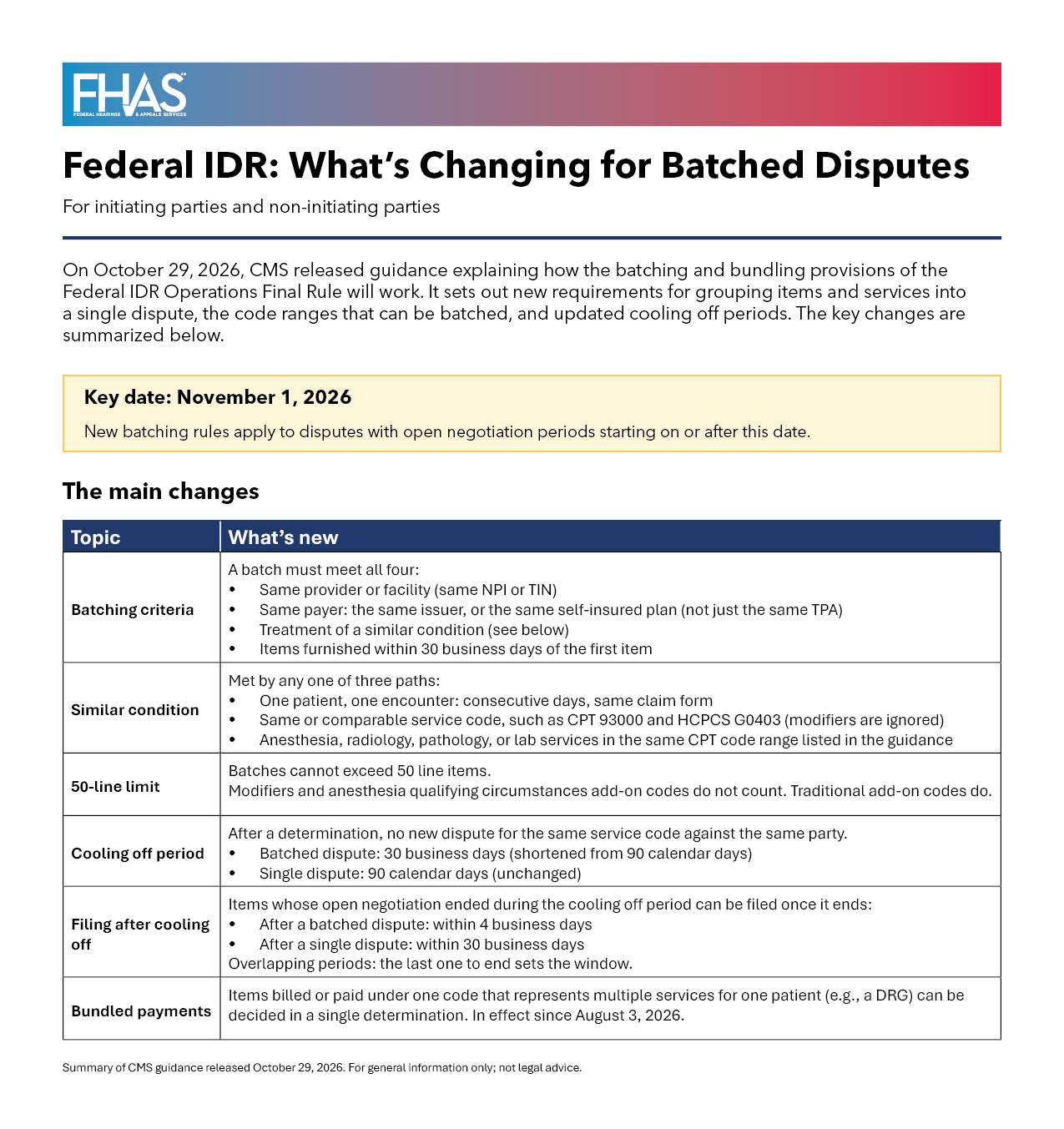
Downloadable image: “Federal IDR: What’s Changing for Batched Disputes“
Four requirements for every batch
Under the final rule, items and services can be batched only if they meet all four requirements:
- Same provider: billed under the same NPI or TIN.
- Same payer: paid by the same health insurance issuer, or by the same self-insured plan. Two self-insured plans that share a third-party administrator are not the same payer.
- Similar condition: related to the treatment of a similar condition, as described below.
- Same time period: furnished within 30 business days of the first item or service in the batch. Items held over by a cooling-off period are the exception.
Every batch also must stay within 50 line items.
Three ways to meet the “similar condition” test
A batch needs to meet only one of these:
- One patient, one encounter. Items and services furnished to a single patient on one or more consecutive days and billed on the same claim form. The codes do not need to match.
- Same or comparable service code. Items and services furnished to one or more patients and billed under the same code, or under a comparable code in a different coding system – for example, CPT 93000 and HCPCS G0403, both a routine 12-lead electrocardiogram. Only the primary service codes need to match, not their modifiers.
- Same CPT code range, for four specialties. Anesthesiology, radiology, pathology, and laboratory services furnished to one or more patients can be batched when their Category I CPT codes fall in the same range listed in the guidance. Items cannot be batched across ranges, and HCPCS codes cannot be added to a CPT range.
The guidance’s examples show how this plays out. A radiologist could batch a head CT (CPT 70450) and a sternum X-ray (CPT 71120) for two different patients, because both fall in the 70010–71555 range. A lumbar spine CT (CPT 72131) falls in a different range, so it could not join that batch.
Specialties without a code range rely on the first two paths. For example, emergency department visits billed at different levels, such as CPT 99284 and 99285, are different codes. They can be batched together within one patient’s encounter, but not across patients.
Does this count toward the 50-line-item limit?
- Service code modifiers do not count.
- Anesthesia qualifying circumstances add-on codes (99100, 99116, 99135, and 99140) do not count. They work like modifiers: they are submitted with the primary anesthesia code and cannot be disputed on their own. Batching is based on the primary anesthesia code.
- Traditional CPT add-on codes, such as +01968, are separate line items, so they do count.
Cooling-off periods and filing windows
After a payment determination, no new dispute may be initiated against the same other party for the same service code until the cooling-off period ends. The guidance confirms that:
- The cooling-off period is 30 business days after a batched determination and 90 calendar days after a single determination.
- Every code in a batched determination is covered.
- Items whose open negotiation period ended during the cooling-off period can be filed after it ends – within 4 business days after a batched period, or within 30 business days after a single period. The 4-business-day window opens on the first business day after a batched cooling-off period ends. The 30-business-day window begins the day after a single cooling-off period ends.
- Each determination starts its own cooling-off period. When periods overlap, the last one to end sets the window.
- Certified IDR entities must find disputes filed during an active cooling-off period ineligible.
For practical steps on tracking cooling-off periods, counting business days, and preparing held-over items to file, see our earlier post, What the New 4-Business-Day Initiation Window Means for Batched IDR Disputes.
Bundled payments
A bundled payment arrangement is one in which a provider bills, or a plan pays or denies payment, under a single service code that represents multiple items or services furnished to one patient. A DRG code is one example; the guidance also cites a bilateral diagnostic mammogram billed under a single CPT code (77066). Bundled items are decided in a single determination. This definition has been in effect since Aug. 3, 2026.
Getting batching right from the start
Most batching problems can be caught before a dispute is filed. As you prepare batches under the new rules, we suggest the following steps:
- Check each batch against all four requirements, and choose one “similar condition” path before initiating.
- Keep the guidance’s CPT code range tables close at hand if you work in anesthesiology, radiology, pathology, or laboratory services.
- Count line items carefully, leaving out modifiers and qualifying circumstances codes.
- Track every payment determination and the date its cooling-off period ends. Our earlier post on the 4-business-day window offers practical tips.
- Use the batching decision tree in the guidance’s appendix as a final check.
For more information
Questions about batching or any part of the Federal IDR process? FHAS is a certified IDR entity, and our team is glad to help. Call 1-800-664-7177 or write to us at IDRE@fhas.com.
Legal Disclaimer
The information contained in this content piece is for general informational purposes only. While we strive to ensure the accuracy and completeness of the information presented, we make no representations or warranties of any kind, express or implied, about the accuracy, reliability, suitability, or availability with respect to the content or the information, products, services, or related graphics contained in the content piece for any purpose. Any reliance you place on such information is therefore strictly at your own risk. The content of this page is subject to change without notice. The information provided in this document does not constitute legal or other professional advice, and is non-binding upon FHAS and any federal government agencies.