
The new Federal IDR final rule is a significant and positive step forward to improve the submission process, clarify the ambiguities, reduce gamesmanship in the system, and make it more accessible for parties to resolve claims.
The much-anticipated and debated final rule was officially announced May 28, and while the changes are largely consistent with the proposed rule, the Departments (Health & Human Services, Treasury and Labor, collectively) made important changes. At the moment, the biggest challenge all stakeholders face is understanding how and when to implement the new regulations.

The goal is clear: to ensure parties submit payment disputes that are complete, eligible, and ready for a merit-based determination.
As a certified IDR entity (IDRE), FHAS is here to ensure neutral, transparent, and timely arbitration and resolution. Making the IDR program work is our job. It is our role is to help parties understand the enhancements, meet the first wave of change, and prepare for the operational updates that will go into effect over the next year. We urge parties to watch this 14-minute FHAS video discussion with Jim Bobeck, CEO, Joe DiPaolo, COO, and Luigi Romano, Director of IDR Services. It is among the first of many resources we’ll be offering to support your implementation of the new regulatory framework for IDR.
First order of business: lower IDR administrative fees effective Thursday, June 11
Next week, the administrative filing fee drops by $100 to a flat $15 — viable for smaller claims and smaller practices — a deliberate choice for simplicity over a more complicated claim-amount formula. The Departments have heard the concerns that elevated fees made it too costly for smaller practices to participate in the process. At the same time, the fees collected far exceeded the Department’s projections. In response, the Departments chose a common sense, simplified approach with one fee for all parties, paid the same way – to the IDRE on the government’s behalf.
However, parties and the IDREs must act fast to update their accounts payable system to ensure compliance with the Thursday, June 11, effective date.
The headline win: clearer eligibility
The single biggest improvement is up-front clarity on eligibility. The IDR final rule changes aim squarely at this central problem. Today, it is complex and resource intensive to determine whether a dispute belongs in IDR. The numbers show why it matters: roughly 17% of cases are found ineligible, and non-initiating parties object on eligibility grounds to about 40% of disputes. Every ineligible filing screened out at the front end returns capacity to the disputes that genuinely need resolution.
The full fix arrives with the new IDR Gateway. This coming portal is positioned throughout the IDR final rule as the single source of truth for identifying information needed to establish eligibility for the Federal IDR process and ensure the right parties are involved. Timing for the availability of the new Gateway portal is not precise, but a phased roll-out is expected to begin this year.
Communication: no longer optional
Better, earlier information exchange is the rule’s connecting theme. Health plans must include standardized claim adjustment reason codes (CARCs) and remittance advice remark codes (RARCs), along with the insurer’s legal business name, plan sponsor information, and a unique IDR registration number, via a new payer registry, when responding to out-of-network claims.
Certified IDREs must determine eligibility within five business days of assignment, and open negotiation moves into the IDR Gateway with defined content requirements and response periods.
The effect for parties: fewer disputes derailed by missing information, far greater transparency, faster answers on eligible submissions, and more credible outcomes.
Batch with confidence and compliance with FHAS now
Previously, the Departments gave IDREs discretion on the application of IDR batching rules, leading to varied approaches and guesswork for parties who had to batch cases prior to IDRE selection. As a result, batching, which is a cost-effective way to resolve some disputes, was underutilized and even risky. The final rule sets a clear, uniform way to process batched claims. FHAS adopted the proposed rule’s batching provisions (now in the final rule) over two years ago, so we have deep expertise adjudicating batched cases in a manner that complies with the new IDR final rule, and we’re happy to provide guidance on the process.
Items may be batched: as a single patient encounter, under the same or comparable service code, or within the same Category I CPT code section for anesthesiology, radiology, pathology, and laboratory services. Further, the Departments heeded feedback during the rule comment period and enlarged batching size to 50 line items from the proposed 25 line items.
Act now: don’t wait for implementation
The IDR Final Rule outlines a voluminous number of changes, but the effective dates and IDR final rule compliance dates differ for each change and will be phased in over the course of the next year.
Most provisions require compliance 90 business days (mid-October) after the effective date of the rule, which is August 3, 2026. So, the clock is ticking on readiness for changes including the codified extenuating-circumstances extensions and enhanced QPA disclosures. The CARC/RARC framework follows its own track: guidance is due six months after publication (early December) with compliance required by early April 2027.
The largest procedural changes depend on the centralized IDR Gateway portal, including the payer registry, the 50-item batching cap and a 30-business-day cooling-off period, the open-negotiation overhaul, revised entity selection, and payment-determination deadlines tied to final IDRE selection. These significant changes require advance planning, so we urge parties to begin preparing now.
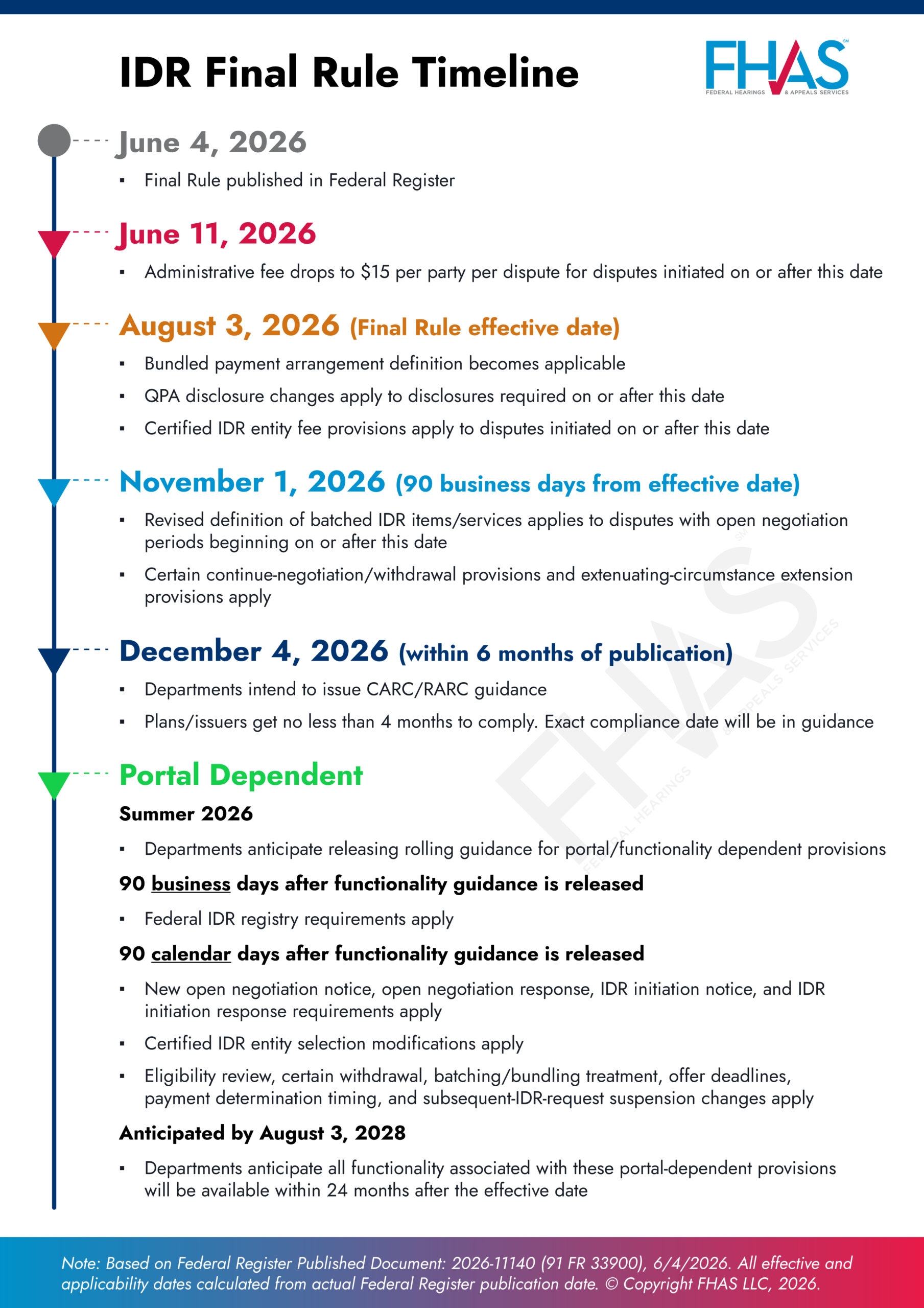
Need Help? Let FHAS be your guide
The direction is unmistakable: a stronger, more disciplined, more transparent process that keeps ineligible disputes out and moves legitimate ones faster.
FHAS is here to help parties understand the IDR final rule, meet the new timeframes, and arrive at IDR ready for a merit-based decision. As the saying goes, it wasn’t raining when Noah built the ark. Preparing for a rising sea of change now will enable parties to navigate the new IDR regulations successfully.
Have questions on the IDR final rule? Contact us to schedule a consultation with our team.
Legal Disclaimer
The information contained in this content piece is for general informational purposes only. While we strive to ensure the accuracy and completeness of the information presented, we make no representations or warranties of any kind, express or implied, about the accuracy, reliability, suitability, or availability with respect to the content or the information, products, services, or related graphics contained in the content piece for any purpose. Any reliance you place on such information is therefore strictly at your own risk. The content of this page is subject to change without notice. The information provided in this document does not constitute legal or other professional advice, and is non-binding upon FHAS and any federal government agencies.
Text